
Wake County Clerk Of Superior Court
Wake County uses North Carolina's unified Clerk of Superior Court model. The clerk is not a separate district clerk or county clerk for court files. The office keeps records for both Superior Court and District Court cases and also serves as judge of probate for estate administration. That means civil actions, criminal cases, traffic matters, family cases, special proceedings, estate files, judgments, liens, executions, divorce judgments, and many copy requests all route through the Clerk of Superior Court.
The Wake County court contact directory is the best official starting point for clerk phone routing. It lists the main Clerk of Superior Court phone as 919-792-4000 and gives direct subject lines for traffic, misdemeanors, felonies, record checks, expungements, estates, judgments, liens, small claims, divorce, custody, special proceedings, finance, magistrates, and court administration.
Clerk of Superior Court
Wake County Courthouse
316 Fayetteville St. Mall
Raleigh, NC 27601
Mailing: PO Box 351, Raleigh, NC 27602
919-792-4000
Monday-Friday, 8:30 a.m.-5:00 p.m.
Criminal, Traffic, and Marriage Venue
Wake County Justice Center
300 S. Salisbury St.
Raleigh, NC 27601
919-792-4000
The Wake County court contact directory gives direct numbers for Clerk of Superior Court records, estates, traffic, felonies, and special proceedings.
Those direct lines are useful because Wake County record requests are split by case type, building, and clerk counter.
Wake County Clerk Records Duties
The Clerk of Superior Court's role is broader than a filing window. North Carolina's state judicial overview describes the clerk as an elected county official who performs clerical and record-keeping work and serves as judge of probate. In Wake County, the clerk is the public route for many court records even when case information can first be viewed through Portal.
Record access has several layers. The N.C. court records help topic explains criminal background checks, expunctions, obtaining court records, and Portal resources. The more specific obtaining court records help topic says public terminals in clerk offices remain an official channel for criminal, civil, special proceeding, and estate case information, while paper files are viewed in the clerk's office where the case is located.
- Keep Superior Court and District Court case files for Wake County.
- Provide clerk counter access to paper files and copies when records are public.
- Process certified copies for legal use when a plain printout is not enough.
- Handle estates and probate as the Clerk of Superior Court, Estates Division.
- Maintain judgment, execution, lien, small claims, divorce, custody, and special proceeding records.
- Collect eligible court costs, fines, fees, and estate payments by the approved Wake County payment methods.
The N.C. court records help topic explains statewide access rules used by the Wake County Clerk of Superior Court.
The help topic reinforces that Portal searches, clerk terminals, and courthouse copy requests serve different needs.
Request Wake County Certified Copies
A certified copy is a clerk-issued copy that carries official certification. It is often needed for legal, title, estate, licensing, or agency use. A Portal view or downloaded page is not the same thing. For Wake County court records, the request should identify the case number if known, names of parties, case type, requested document, and whether the copy must be plain or certified.
Criminal, traffic, misdemeanor, and felony counters are tied to the Wake County Justice Center. Civil, family, special proceeding, and estate payments and file work point to the Wake County Courthouse. If a requester is unsure which counter holds the record, the Clerk of Superior Court main number or the direct topic numbers from the contact directory can help route the question.
- Search Portal, a clerk terminal, or existing paperwork for the exact Wake County case number and party names.
- Identify the document needed, such as a judgment, disposition, order, divorce decree, letters, or estate filing.
- Contact or visit the correct Wake County clerk counter and state whether a plain or certified copy is needed.
- Pay the required copy or certification fee by an accepted court payment method.
- Use the certified copy for legal submission, and keep the clerk receipt with the record when possible.
The official obtaining court records help topic describes clerk terminals, paper files, and copy requests for Wake County Clerk records.
That distinction is important when a Wake County search result must become a certified paper copy.
Wake County Clerk Access Channels
Wake County court records are not held in a county-owned search portal. The statewide N.C. eCourts Portal is the online path for case information, hearing dates, judgment search, and some payments. Public terminals in clerk offices remain available for criminal, civil, special proceeding, and estate information. Complete paper files are reviewed at the clerk's office in the county where the case is located.
The Wake County Trial Court Administrator's Office is not a filing office. The official page states that filings must go to the clerk, not to the Trial Court Administrator. The TCA page is still useful for court administration contacts, civil superior proposed orders, remote hearing Webex information, and media recording order references.
| Channel | Best use | Limit |
|---|---|---|
| eCourts Portal | Case information, hearings, judgments, and some payments | Not a certified copy or complete paper file. |
| Public self-service terminal | Criminal, civil, special proceeding, and estate searches | File review still belongs at the county clerk office. |
| Paper file at clerk office | Complete file review where public access is allowed | Restricted, sealed, juvenile, and expunged records may be unavailable. |
| Certified copy request | Legal-use copies of judgments, orders, dispositions, and estate papers | Fees apply and document details are needed. |
| File & Serve | Electronic filing in eCourts case types | Filing status and acceptance are controlled by the clerk process. |
The Trial Court Administrator's Office page points Wake County users back to the Clerk of Superior Court for filings.
The page helps separate court administration questions from actual filing, copy, and court-record requests.
Wake County Records Request Inventory
A clear request reduces clerk follow-up. The research identifies a standard information set that should be included when asking for a Wake County court case copy: case number if known, party names, case type, county, requested document, copy type, and requester contact details. ID may be needed for restricted files or records that are not open to all public users.
| Field | Required | Notes |
|---|---|---|
| Case number | Strongly preferred | Use the exact number from Portal, a filing, citation, or judgment entry. |
| Party names | Yes | Include full names and business names when relevant. |
| Case type | Yes | Criminal, civil, traffic, family, estate, special proceeding, judgment, or divorce. |
| Document requested | Yes | Examples include disposition, order, judgment, divorce judgment, letters, or inventory. |
| Copy type | Yes | State whether plain or certified copies are needed. |
| Requester contact | Yes | Give phone, email, or mailing address for clerk follow-up. |
Wake County Clerk Fees
The official Wake payment page separates payment rules by case type. Traffic and criminal payments are handled at the Justice Center. Civil, family, special proceeding, and estate payments are handled at the Courthouse. Copy and certification costs depend on the current court fee schedule and document type, so the exact amount should be confirmed with the clerk before mailing a request.
| Item or channel | Amount or rule | Wake County source detail |
|---|---|---|
| Traffic/criminal payment by mail | Money order or certified check only | Payable to Wake County Clerk of Superior Court; no cash or personal checks. |
| In-person court payments | Cash, credit/debit plus fees, money order, certified check | Personal checks are not accepted. |
| Copy of court documents | Fee applies | Exact copy and certification fee depends on court fee schedule and document type. |
| Uncertified public-record copy limit | Actual cost unless another law applies | G.S. 132-6.2 allows special service charges for extensive requests. |
| Estate opening filing fee | $120 | Listed by the statewide estates help topic. |
Wake County payment information explains how Clerk of Superior Court payments are split by case type and building.
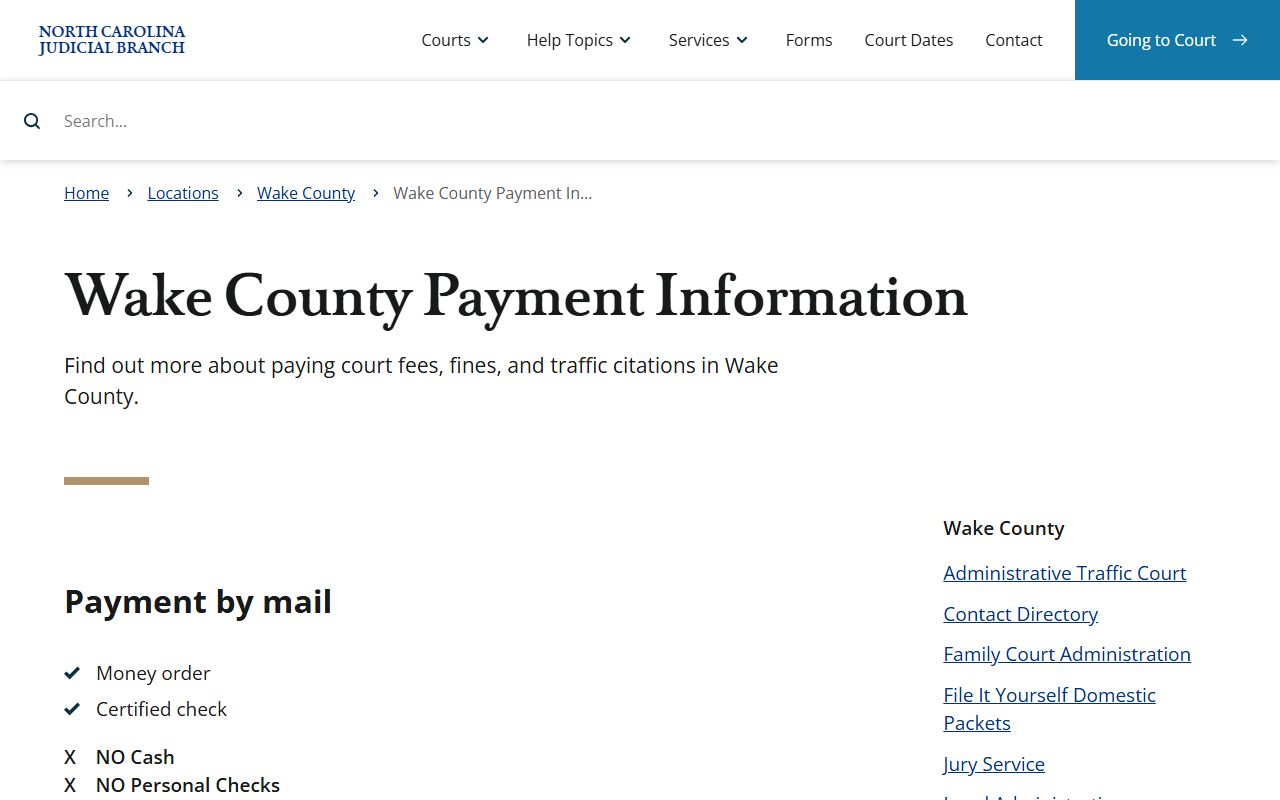
Payment routing is a practical issue because civil and estate payments do not use the same counter as traffic and criminal payments.
Wake County Forms And ROD Split
Common clerk form work includes expunction petitions, estate forms, civil filings, domestic matters, special proceedings, and eCourts filings through File & Serve where eFiling applies. Portal and File & Serve are related to eCourts, but they serve different jobs. Portal is for public case information, hearing search, judgments, and payments. File & Serve is for submitting filings in supported eCourts case types.
The Register of Deeds is a separate Wake County office. Tammy L. Brunner is the Wake County Register of Deeds. The ROD keeps deeds, deeds of trust, plats, business names, notary oaths, DD214s, birth certificates, death certificates, and marriage certificates. It also issues marriage licenses. Divorce judgments, estate files, criminal dispositions, civil orders, and traffic court records remain Clerk of Superior Court records.
| Record | Wake County office | Reason |
|---|---|---|
| Divorce judgment | Clerk of Superior Court | It is a court case record. |
| Marriage license or certificate | Register of Deeds | The ROD issues and certifies Wake marriage records. |
| Estate file or letters | Clerk of Superior Court, Estates Division | The clerk serves as probate judge. |
| Deed or deed of trust | Register of Deeds | Land records are recorded by the ROD. |
| Criminal disposition | Clerk of Superior Court | It is part of the court case file. |
File & Serve is the eCourts filing channel connected to Wake County Clerk of Superior Court case work.
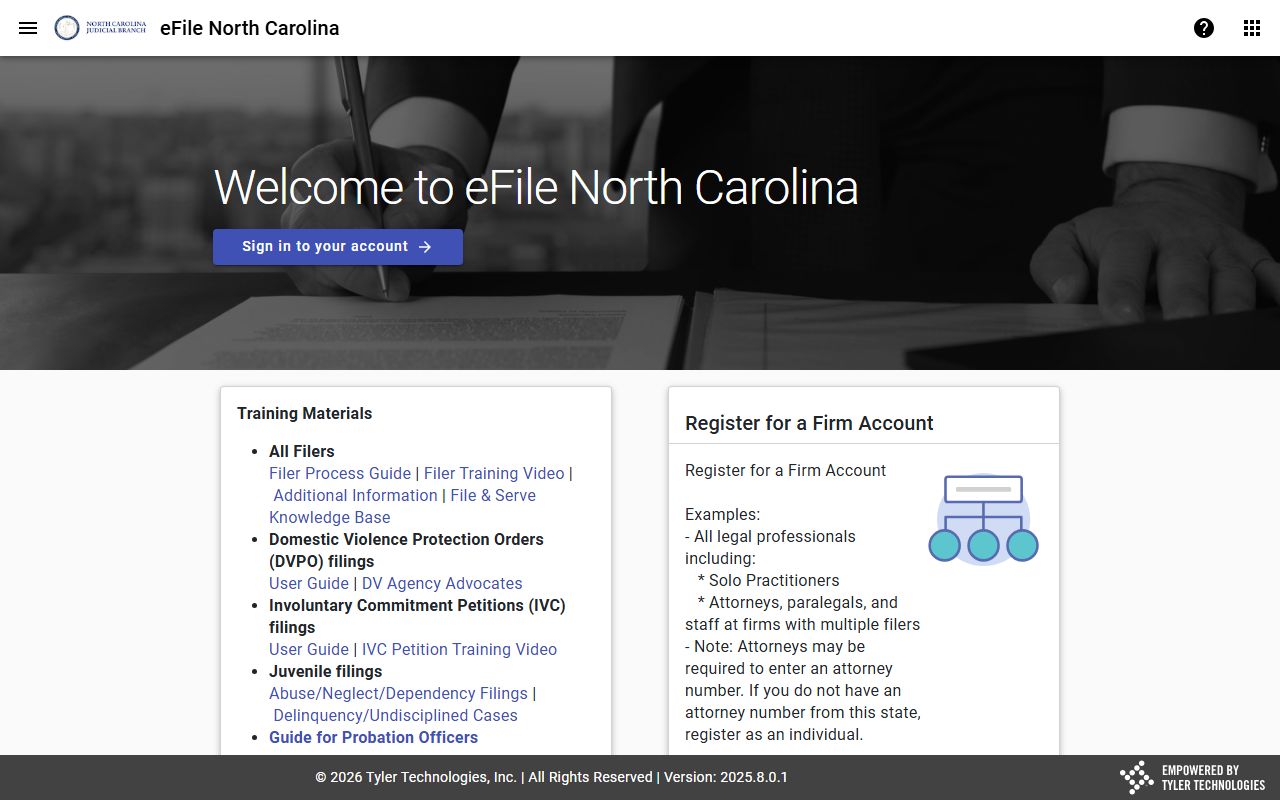
For public users, the practical split is simple: Portal helps search, File & Serve helps file, and certified copies still come from the clerk.