
Wake County Warrant Channels
Wake County warrant records are split across practical access channels. The Wake County Sheriff's Office Police-to-Citizen portal is the local public-safety entry point. Its official application routes include wanted-person and most-wanted catalogs. Those routes support public searching when the Sheriff's Office has configured fields and results for display. A P2C result is still a public tool, not a clerk-certified court record and not a promise that every active warrant in Wake County appears online.
Warrants also connect to the state court system. Missed court dates, criminal charges, failures to appear, and orders for arrest are often tied to District Court or Superior Court records. The N.C. eCourts Portal can be used for related case lookup, hearing dates, and case status when the information is public. For active status, Wake County residents may need the Wake County Sheriff's Office, the Clerk of Superior Court criminal or record-check contacts, the Wake magistrates, or an attorney.
The Sheriff's P2C home page is the source for Wake County public-safety search routes shown in the local research. Use it as the lead online path for wanted-person tools before moving to court records or direct phone confirmation.
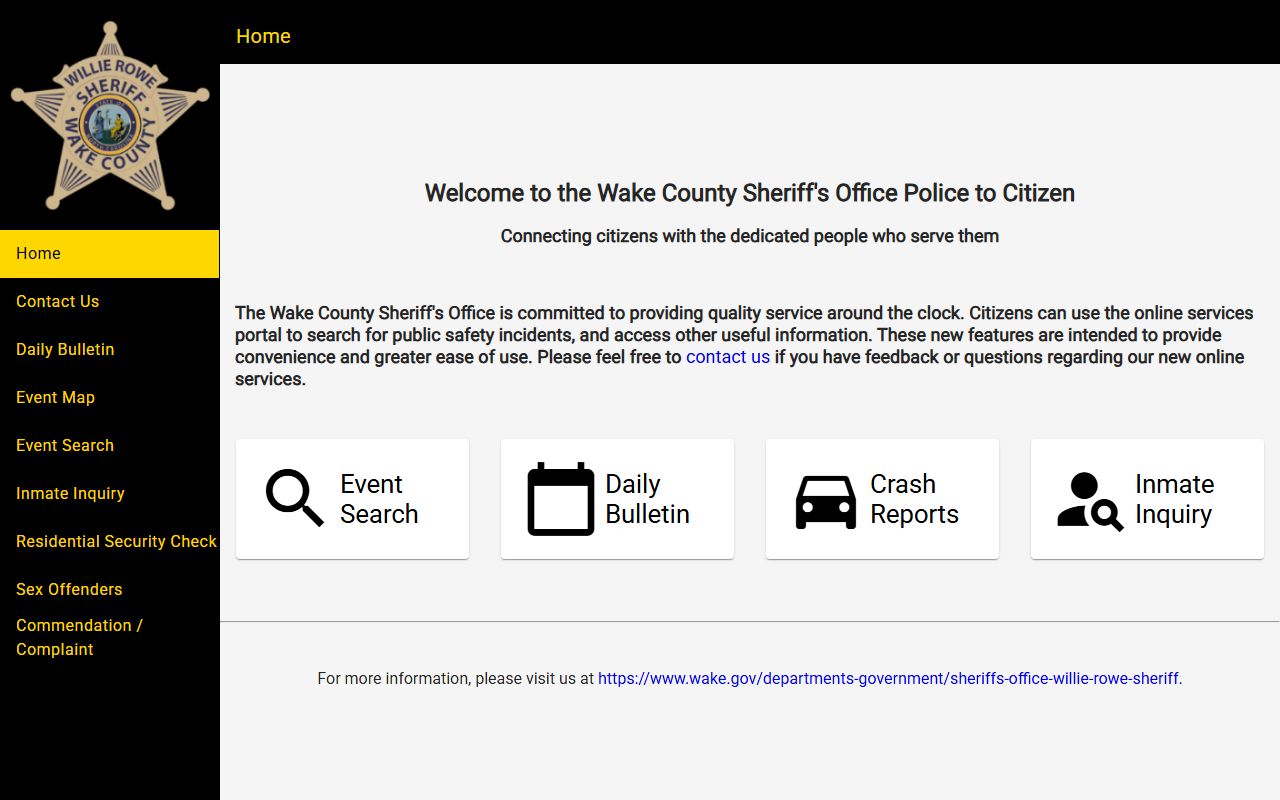
The P2C portal is useful for sheriff-facing warrant information, while the court portal is better for the case history that may explain why an order was issued.
Wake County Warrant Types
Wake County warrant language can vary by setting. A person searching an online wanted list may see charge text, a warrant type, or a warrant number if those fields are enabled. A court file may instead show an order for arrest, criminal summons, failure-to-appear event, or returned warrant entry. North Carolina's electronic warrant systems, including law-enforcement and court systems, are not general public search databases.
- Arrest warrant authorizes law enforcement to take a person into custody based on a criminal process.
- Bench warrant or order for arrest may follow a missed court date, contempt matter, or other court order.
- Search warrant authorizes a search of a place, item, device, or person under court rules.
- Criminal summons orders a person to appear without immediate arrest, but it can still appear in case history.
- Most-wanted notice is a sheriff public-information entry, not the complete court file.
How to Search Wake County Warrants
The best Wake County warrant search starts with the sheriff P2C wanted-person routes, then checks court records for the related case. The Wake P2C Wanted Persons catalog is the direct route documented in the research. The separate Wake P2C Most Wanted catalog may show more descriptive profile fields, images, alerts, or wanted-for details when those fields are public.
- Search P2C by name or browse the wanted-person catalog where the route is available.
- Compare name, age, sex, race, charge text, warrant type, and warrant number if the result shows them.
- Use eCourts Portal Smart Search or Search Hearings for related Wake County criminal cases, court dates, failures to appear, and dispositions.
- Call the Wake County Sheriff's Office or the Wake magistrates if current status affects safety, surrender, bond, or court appearance plans.
- Use counsel when the result may involve a pending criminal case, a failure to appear, or an order for arrest.
The Wake P2C Wanted Persons catalog is the researched direct catalog route for wanted-person entries. It should be read with care because live field display depends on Wake County Sheriff's Office settings.
When a P2C entry points to a charge, the court record may give the broader case context, including hearings and disposition history.
Wake County Warrant Search Fields
The Wake County P2C warrant modules are dynamic. The research confirms the fields built into the official application bundle, but live public display can change by setting. Some fields may be search fields, sort controls, or display fields rather than required inputs. Name matching should be checked carefully because common names can return unrelated people.
| Field Label | Type | Required | Options / Format Notes |
|---|---|---|---|
| Search text | Text | No | General wanted-person search across configured catalog text. |
| First / middle / last name | Text | Optional | Person-name search and sorting are supported depending on the module. |
| Filter | Button | Optional | Opens filters configured by the Wake P2C module. |
| Sort | Dropdown | Optional | Wanted Persons defaults include Last Name A-Z in the bundle. |
| Warrant Number | Display or search field | Optional | Display is controlled by the DisplayWarrantNumber setting. |
| Charge | Display or filter | Optional | May be hidden when the HideWarrantCharge setting is active. |
| Warrant Type | Display or filter | Optional | May be hidden when the HideWarrantType setting is active. |
Note: A missing P2C result does not prove that no Wake County warrant, order for arrest, or sealed process exists.
Wake County Warrant Record Fields
A Wake County warrant result may be brief. Wanted-person results focus on identity and the reason a person is wanted. Most-wanted profiles can be richer because they may include photos, alerts, characteristics, or physical descriptors. Court records, by contrast, can show case number, charge history, hearings, disposition, and related financial entries when public access rules allow.
| Field | What It Shows |
|---|---|
| Full name | The person named in the wanted-person or most-wanted entry. |
| Sex, race, and age | Identity fields used to distinguish people with similar names. |
| Charge or wanted-for text | The charge description or public reason listed by the sheriff module. |
| Warrant type | The type of warrant when Wake settings allow it to display. |
| Warrant number | An identifying number if the DisplayWarrantNumber setting is enabled. |
| Photo and descriptors | Image, height, weight, traits, alerts, and scars or tattoos in most-wanted profiles. |
Wake County Warrant Fallbacks
Direct contact matters when a Wake County warrant search could affect arrest risk, bond, custody, or a court date. The Wake County Sheriff's Office main number is 919-856-6900. The sheriff records division number is 919-856-6600. The jail number is 919-856-5953 for custody status after an arrest. Wake magistrates can be reached through 919-792-4900, and the court contact directory lists criminal, traffic, record-check, and disposed-case contacts through the Clerk of Superior Court.
Wake County Sheriff's Office
John H. Baker Public Safety Center
330 S. Salisbury St.
Raleigh, NC 27601
919-856-6900
Wake County Magistrates
Wake County Justice Center
300 S. Salisbury St.
Raleigh, NC 27601
919-792-4900
Wake County does not have separate justice-of-the-peace warrant courts or a stand-alone local warrant court. Bench warrants and orders for arrest route through North Carolina District Court, Superior Court, magistrates, and law-enforcement service channels.
Resolve Wake County Warrants
An outstanding Wake County warrant should be verified before a person acts on an online entry. P2C data can lag. Court records can show a related case but not every current enforcement detail. A person with counsel should contact counsel first. A person without counsel may need to confirm the issuing court, the charge level, the next court date, and the likely booking or bond process before appearing.
- Confirm the warrant or order for arrest through counsel, WCSO, a magistrate, or the court record.
- Identify whether the matter is a District Court traffic or misdemeanor case, a Superior Court felony case, or another court process.
- Do not rely on stale search results when surrender, bond, travel, or employment consequences are at stake.
- Ask about facility rules, medication needs, personal property, and release conditions before turning yourself in.
- After service or recall, allow time for public systems to update.
Important: Court and sheriff staff can route public questions, but they do not replace legal advice about surrender or defense options.
Restricted Wake County Warrants
Public warrant access has limits under North Carolina law. G.S. 132-1.4 treats many criminal investigative records as nonpublic, but returned warrants, indictments, criminal summonses, and nontestimonial identification orders are public unless sealed. That distinction matters in Wake County because an active investigation may be closed to the public while a returned court process may later be open.
Juvenile records, sealed court records, expunged matters, protected personal data, and some law-enforcement recordings are restricted. Returned warrants can also be sealed by court order. For a broader case outcome, search the related Wake County criminal court record, but do not assume Portal or P2C is a background-check service.
The Wake P2C Most Wanted catalog is the researched route for higher-detail wanted profiles. It can show more public descriptors than a standard wanted-person result when WCSO makes those fields available.
Most-wanted information is a sheriff public-information tool, while court and statutory restrictions still control what case documents can be inspected.