
Wake County Arrest Records and Court Charges
Wake County arrest records come from law-enforcement and detention activity. They may identify the arrested person, arrest date and time, agency, charge description, bond, court date, case number, and related booking or custody details when the Wake County Sheriff's Office Police-to-Citizen system displays them. The court charge record is different. It is the charge filed in District Court or Superior Court and tracked through the court case.
After an arrest, a magistrate, officer, prosecutor, or grand jury process can move an allegation into court. The District Attorney for Prosecutorial District 10 represents the State in criminal cases, prepares criminal trial dockets, and prosecutes cases in District and Superior Courts. The full case file, including pleas, motions, disposition, and sentence, belongs with Wake County criminal court records. Jail custody and roster details belong with inmate records and sheriff systems.
The image below comes from the Wake County Sheriff's Records Division.
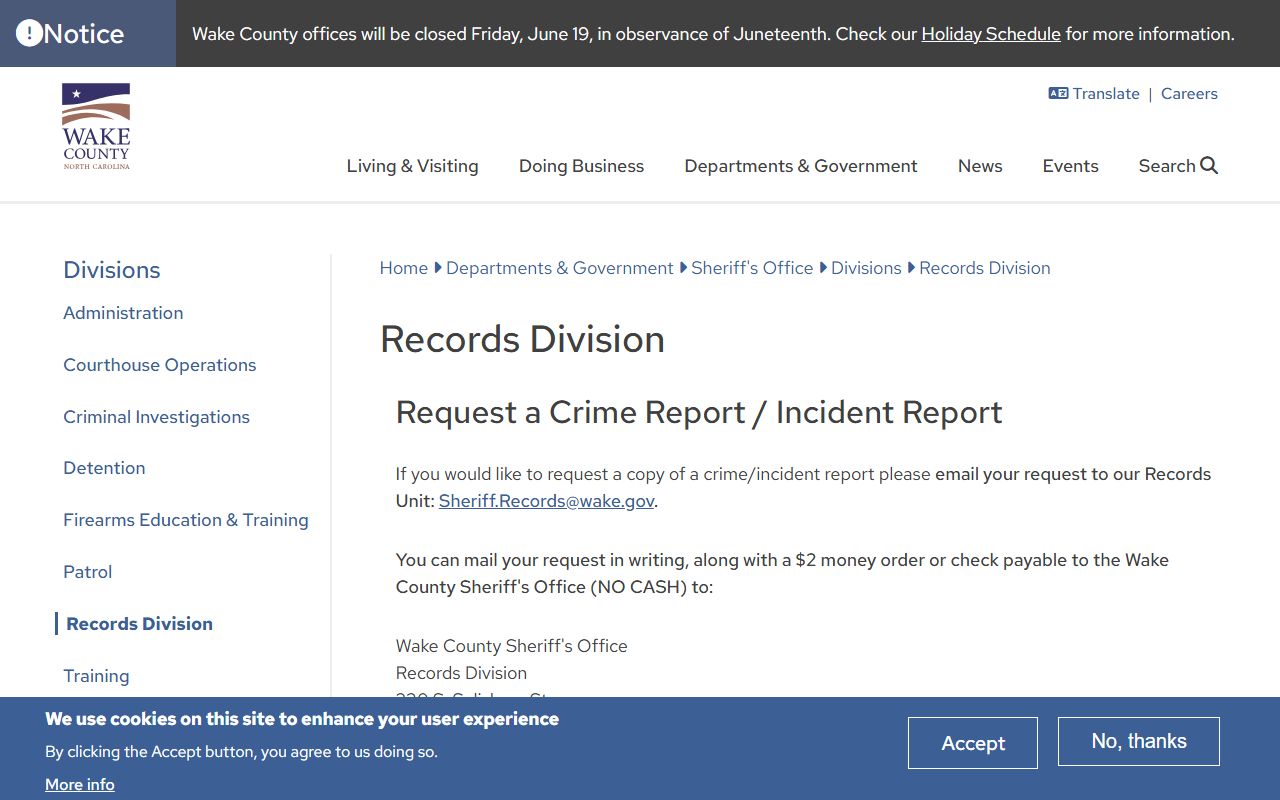
The sheriff record path is essential for incident reports, while court charge status belongs in the court case record.
Find Wake County Arrest Records
The sheriff's online route is the Wake County Sheriff's Office Police-to-Citizen portal. Research confirms a P2C Recent Arrests catalog route and an inmate inquiry route. The dynamic app controls live display settings, so a visible result should be treated as a starting point, not a final court disposition.
- Search the sheriff's P2C portal for recent arrest or custody information when the need is arrest-side detail.
- Record the person's name, arrest date, charge wording, bond, court date, agency, and case number if shown.
- Use the eCourts Portal to search for the matching court charge or criminal case by name or case number.
- Compare the charge list against the disposition field before treating any charge as an outcome.
- Request incident reports from the Sheriff's Records Division by email, mail, or fax when a report copy is needed.
- Use the Clerk of Superior Court for certified court copies, disposed cases, and expunction questions.
The Sheriff's Records Division accepts crime or incident report requests through sheriff.records@wake.gov, mail, or fax. The research lists a $2 fee by money order or check for mailed incident report copies. Criminal history reports are routed to CCBI rather than handled as a sheriff incident report request.
Wake County P2C Recent Arrests
Wake P2C recent arrests are useful for the arrest side of a record. The route can display arrestee information, arrest date and time, charges, bond, court date, court name, agency, and case number depending on public settings. Some P2C modules also support vehicles or property details, but those are not the same as court filings or clerk-certified copies.
| P2C Field | What It Can Show |
|---|---|
| Arrestee | Name or public person label in the recent-arrest result. |
| Arrest date and time | When the arrest event was recorded. |
| Charge | Charge text attached to the arrest record, subject to later court changes. |
| Bond | Bond amount or condition where P2C displays it. |
| Court date / court name | The first known court setting or court label when present. |
| Agency | Law-enforcement agency connected to the arrest. |
| Case number | Identifier that can help match the arrest to a court case. |
The next image comes from the Wake P2C Recent Arrests catalog.
P2C recent arrests help identify the arrest event, but court charges must still be checked in eCourts or with the clerk.
Charges After Arrest Documents
Charges after arrest reach court through formal charging documents. Wake County research names returned warrants, indictments, and criminal summonses as public records unless sealed under North Carolina criminal-investigation law. An indictment is a formal felony charging document returned by a grand jury. A criminal summons orders a defendant to appear without immediate arrest. A warrant authorizes arrest, search, or another law-enforcement action.
| Document | Who Uses It | What It Does | Wake County Context |
|---|---|---|---|
| Complaint or citation | Officer or charging authority | Starts or supports a lower-level criminal or traffic matter. | Often tied to District Court misdemeanors or infractions. |
| Information | Prosecutor | States formal charges without a grand jury indictment where allowed. | Use the filed court record to confirm whether this document applies. |
| Criminal summons | Court process | Orders a person to appear without immediate arrest. | Public when returned unless sealed by law or court order. |
| Indictment | Grand jury | Formally charges many felony matters. | Usually tied to Superior Court felony case records. |
| Returned warrant | Court and law enforcement | Shows warrant process after service or return. | Public unless sealed under G.S. 132-1.4(k). |
Wake County Charge Status
A charge can change after arrest. Prosecutors can proceed, amend, reduce, dismiss, or present felony matters for indictment. A court may enter a plea, verdict, disposition, or sentence later in the same file. For that reason, Wake County arrest records should be matched to court charge status before any conclusion is drawn.
| Status | What It Means | Where to Check |
|---|---|---|
| Pending | The charge remains open and has not reached final disposition. | Portal hearing and case search, clerk terminal, or clerk counter. |
| Amended | The charge wording, statute, severity, or count changed. | Case docket and charge history. |
| Reduced | The charge was lowered to a less serious offense or level. | Disposition and plea fields. |
| Dismissed | The charge was ended without conviction on that charge. | Disposition field and certified clerk record. |
| Not guilty | The charge ended in a finding or verdict against guilt. | Final disposition and judgment entry. |
| Guilty | The charge resulted in a guilty plea, verdict, or finding. | Disposition, judgment, and sentence fields. |
Note: An arrest entry alone does not prove a conviction; the Wake County court disposition controls the outcome.
Wake County Charges vs Convictions
Charge records and conviction records answer different questions. A charge states what was alleged after an arrest or criminal process. A conviction states the court outcome after a plea, verdict, or finding. The same Wake County arrest can lead to several charges, and each charge can have a different status.
| Point | Charge | Conviction |
|---|---|---|
| Meaning | An accusation filed in court. | A final guilty plea, verdict, or finding. |
| Timing | Near arrest, summons, indictment, or first filing. | After court action resolves the charge. |
| May change? | Yes, it can be amended, reduced, or dismissed. | It can be appealed or later affected by expunction if eligible. |
| Best source | Court charge list and docket. | Disposition, judgment, and sentence in the court file. |
Statewide Arrest and Charge Lookups
The North Carolina Department of Adult Correction offender searches are not a Wake County jail roster. They cover state prison offenders, probationers, parolees, NC SAVAN, the sex offender registry, and related state-level tools. That makes them useful after conviction, supervision, or state custody, but not as a replacement for Wake P2C or Wake court records.
VINELink and NC SAVAN can help with custody and victim notification information. They should be checked as notification tools, not as the official court charge record. For court charges after arrest, match the name and case number to Portal, public terminals, or the Clerk of Superior Court.
The image below comes from the N.C. Department of Adult Correction offender searches page.
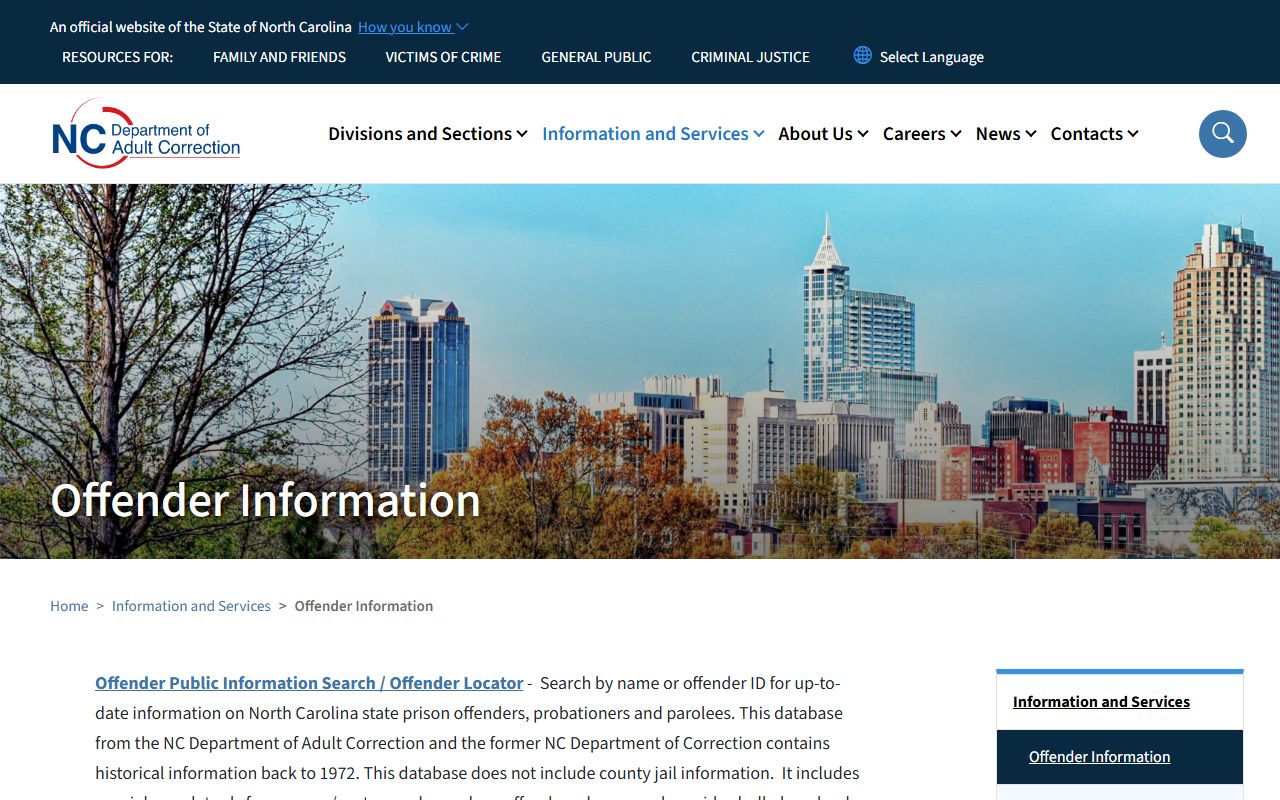
State offender searches may confirm prison, probation, or parole status, but they do not replace Wake County arrest or court charge searches.
The next image is from VINELink.
Notification tools can help track custody events after arrest, while charge status still depends on the court case record.
Restricted Wake County Charge Records
North Carolina law limits some arrest and charge information. Criminal investigative records are generally not public records under G.S. 132-1.4, although returned warrants, indictments, criminal summonses, and nontestimonial identification orders are public unless sealed. Juvenile court records are confidential under G.S. 7B-3000. Expunction can clear qualifying public records of dismissed charges, not-guilty findings, and some eligible convictions.
Sealed records remain in the system but are not open to ordinary public review. Expunged records are cleared from ordinary public access under Chapter 15A procedures. Wake County's court contact directory lists record checks, expungements, driver's licenses, and disposed cases at 919-792-4325. The DA's office cannot give legal advice to people charged with offenses, including explanations of charges, insurance points, or driver's license points.
| Point | Sealed | Expunged |
|---|---|---|
| Public access | Blocked or limited by law or court order. | Cleared from ordinary public record checks after the order is processed. |
| Record status | The record still exists but access is restricted. | The public record is treated as cleared under Chapter 15A procedures. |
| Common source | Juvenile, protected, or court-sealed material. | Dismissed charges, not-guilty findings, or eligible nonviolent convictions. |
The final image comes from the Wake Sheriff's Office mobile app link.
The sheriff app is part of the law-enforcement access path, while certified court charge records still come from court sources.