
Wake County Criminal Court Records
A Wake County criminal court record is the clerk-maintained case file for a prosecution. It starts when a criminal matter is filed or transferred into court and can include returned warrants, criminal summonses, indictments, bonds, appearances, pleas, motions, orders, dispositions, sentences, probation terms, restitution, fines, costs, and appeal entries. It should not be treated as the same thing as a police incident report or a jail roster entry.
Wake County criminal matters are handled at the Wake County Justice Center. District Court handles most misdemeanors, infractions, traffic matters, and many first-level criminal settings. Superior Court handles felony cases and appeals from District Court misdemeanors and infractions. The Clerk of Superior Court keeps the record for both divisions. For the charge pathway before and just after arrest, use the Wake County arrest records and court charges page; the full criminal case file and outcome belong here.
The image below comes from G.S. 15A-146, expunction for dismissed charges and findings of not guilty.
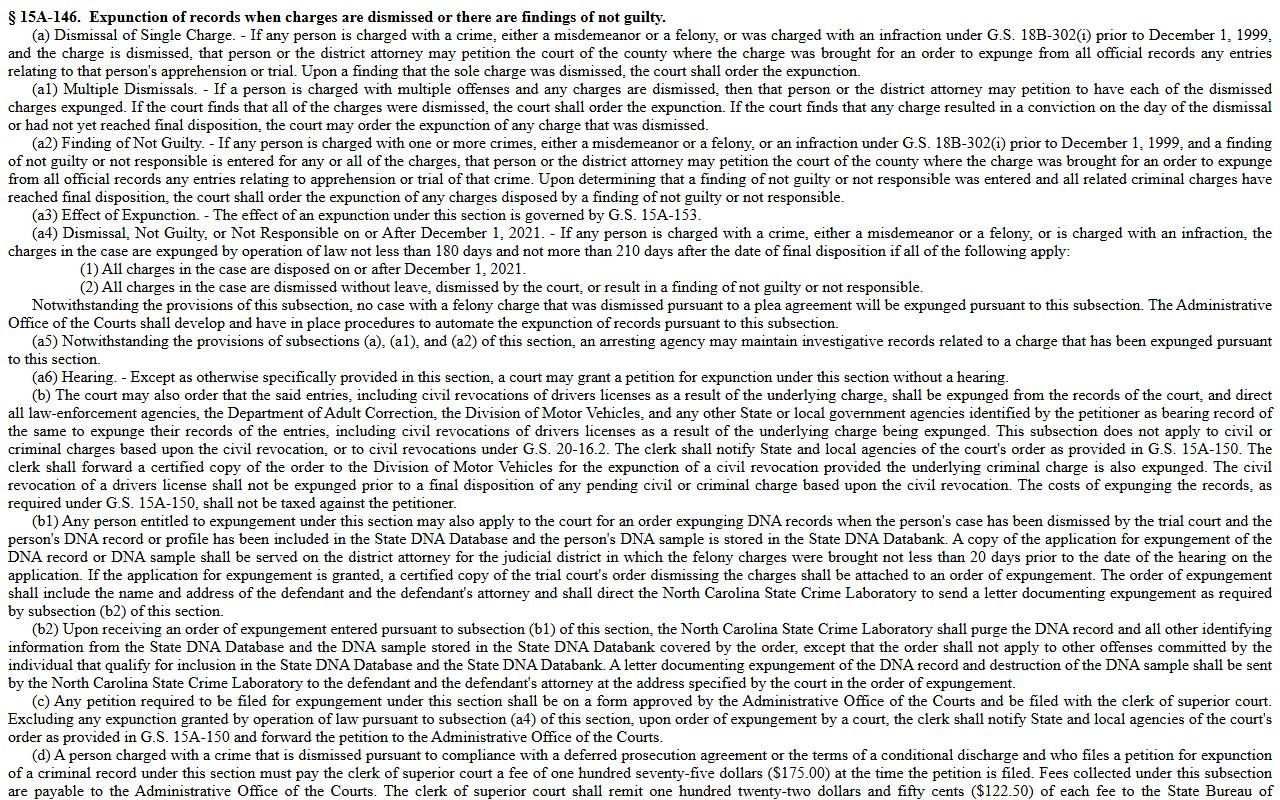
Dismissed charges can still appear in a criminal case history until an expunction process clears qualifying public records.
Search Wake County Criminal Court Records
The main online path is the North Carolina eCourts Portal. The Portal training resources describe Smart Search for case information and Search Hearings for court dates. For criminal matters, search by defendant name, case number, citation number where relevant, attorney, or other Portal fields. For a certified copy or a full file, use the Clerk of Superior Court.
- Open Portal and run Smart Search by defendant name or case number.
- Filter to Wake County or the Wake court location where the option appears.
- Open the criminal case result and compare the case number, defendant name, court division, charge list, and status.
- Use Search Hearings for upcoming appearances by case number, party name, attorney, judicial officer, or courtroom.
- Request a certified copy or paper file review from the Clerk of Superior Court when the online record is not enough.
The Judicial Branch warns that people performing criminal background checks should use the county clerk's office rather than relying only on Portal. Public terminals in clerk offices can be searched by defendant name, case number, or victim/witness name for criminal case information. Complete police reports, investigative files, and discovery materials are separate records and may be restricted.
Wake County Criminal Case Flow
Criminal court records are easiest to read as a sequence. One case may have several charges, and each charge may move through the file at a different pace. A felony may begin with an arrest, warrant, or other charging event, then move through District Court settings before Superior Court indictment or disposition. A misdemeanor may stay in District Court unless appealed.
Case flow: Charges Filed › Arraignment › Pretrial and Motions › Plea or Trial › Disposition › Sentencing
| Stage | What Happens |
|---|---|
| Charges filed | A warrant, summons, citation, information, or indictment creates the court charge record. |
| Arraignment or first settings | The defendant is advised of the charge and the case is scheduled for further court action. |
| Pretrial and motions | Attorneys file requests, discovery issues are addressed, and hearings may be set or continued. |
| Plea or trial | The charge is resolved by plea, trial verdict, dismissal, or another final case action. |
| Disposition | The record shows the outcome for the charge or case. |
| Sentencing | The court enters punishment, costs, restitution, probation, or other conditions after conviction. |
Wake County Criminal Record Fields
A Wake County criminal court record may show more than one layer of information. The case header identifies the file. The charge section identifies the alleged offense. The docket shows events. The disposition and sentence show the court result. A public online view may show less than the complete clerk file, especially when documents are restricted or the case is old.
| Field | What It Shows |
|---|---|
| Case number | The file number, often using North Carolina criminal codes such as CR or CRS. |
| Defendant | Name and identifying details allowed for public display. |
| Court division | District Court for many misdemeanors and infractions; Superior Court for felonies and appeals. |
| Charges | Charge description, statute, severity, and count information when displayed. |
| Bond | Release condition entries, bond type, or bond-related events when part of the court record. |
| Plea | The defendant's formal response, such as guilty, not guilty, or another allowed plea entry. |
| Docket events | Motions, orders, continuances, hearings, notices, and related court actions. |
| Disposition | Dismissed, guilty, not guilty, responsible, judgment entered, or other outcome language. |
| Sentence | Active time, probation, restitution, fines, costs, fees, or other court-ordered conditions. |
| Appeal | Entries showing appeal from District Court or appeal activity after disposition. |
The next image comes from G.S. 15A-153 on the effect of expunction.
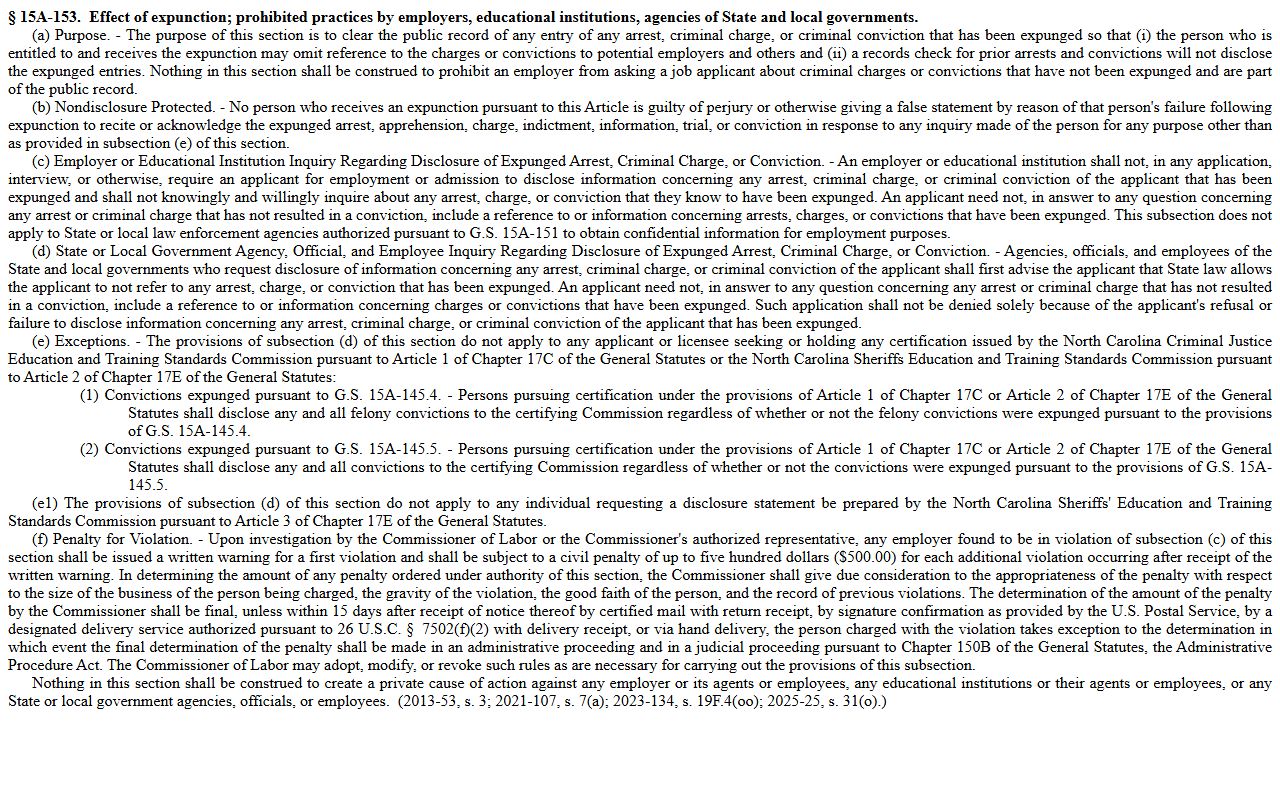
Expunction law is central to criminal court records because it controls what ordinary public searches should no longer disclose.
Wake County Charges vs Convictions
A charge is an accusation in the court record. A conviction is a final result based on a guilty plea, verdict, or finding of responsibility where the law treats the outcome as a conviction. Wake County criminal court records can show charges that were dismissed, reduced, amended, or ended in a not-guilty finding. Reading only the charge line can give a false impression of the outcome.
| Point | Charge | Conviction |
|---|---|---|
| Meaning | An allegation filed in court. | A final guilty plea, verdict, or finding. |
| Timing | Appears near the start of the case. | Appears after plea, trial, or judgment. |
| Record risk | May remain public unless dismissed and expunged or sealed by law. | May affect sentencing, licensing, employment review, or DMV reporting. |
| Best field to check | Charge description and statute. | Disposition, judgment, and sentence fields. |
Public Access to Wake County Criminal Records
Adult criminal court records are generally searchable through court systems unless a statute, court order, expunction, or confidentiality rule blocks access. G.S. 132-1.4 limits criminal investigative records, but returned warrants, indictments, criminal summonses, and nontestimonial identification orders are public unless sealed. G.S. 7A-109 governs clerk record keeping and electronic access terms.
The District Attorney for Prosecutorial District 10 prosecutes state criminal cases in Wake County. The District Attorney page names Lorrin Freeman and lists the office phone as 919-792-5000. The DA represents the State, prepares criminal trial dockets, and advises law enforcement, but the office does not provide legal advice to charged people. The Wake County Public Defender serves Defender District 10 and is not a public-records office.
Note: Use the clerk for criminal court copies; use the investigating agency for police reports and discovery-related records.
The image below is from G.S. 7B-3000 on juvenile court record confidentiality.
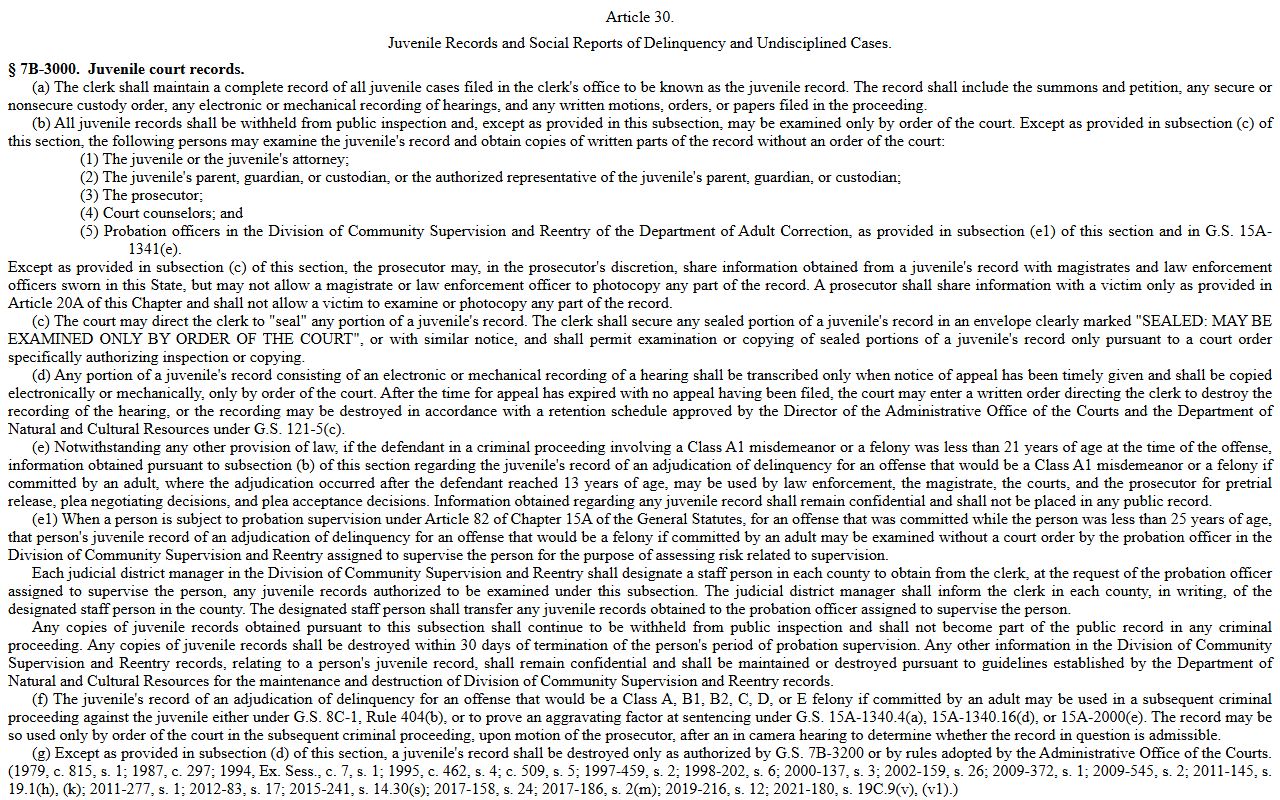
Juvenile confidentiality is one of the strongest limits on public criminal-style court record access in North Carolina.
Sealed vs Expunged Criminal Records
Sealing and expunction are not the same. A sealed Wake County criminal court record remains in the court system but is not open to ordinary public inspection. An expunction is stronger because North Carolina law treats the qualifying public record as cleared from ordinary access. The Wake court contact directory lists record checks, expungements, driver's licenses, and disposed cases at 919-792-4325.
| Point | Sealed | Expunged |
|---|---|---|
| Public view | Hidden or limited by court order or statute. | Cleared from ordinary public record checks after order processing. |
| Record status | Still exists but access is restricted. | Public record is cleared under Chapter 15A procedures. |
| Examples | Sealed filings, protected details, certain confidential proceedings. | Dismissed or not-guilty charges under G.S. 15A-146, and some eligible nonviolent convictions under G.S. 15A-145.5. |
| Where to start | Clerk or attorney for access authority. | Current Judicial Branch forms filed in the county where the charge was brought. |
The next image comes from G.S. 7B-2901 on abuse, neglect, and dependency record confidentiality.
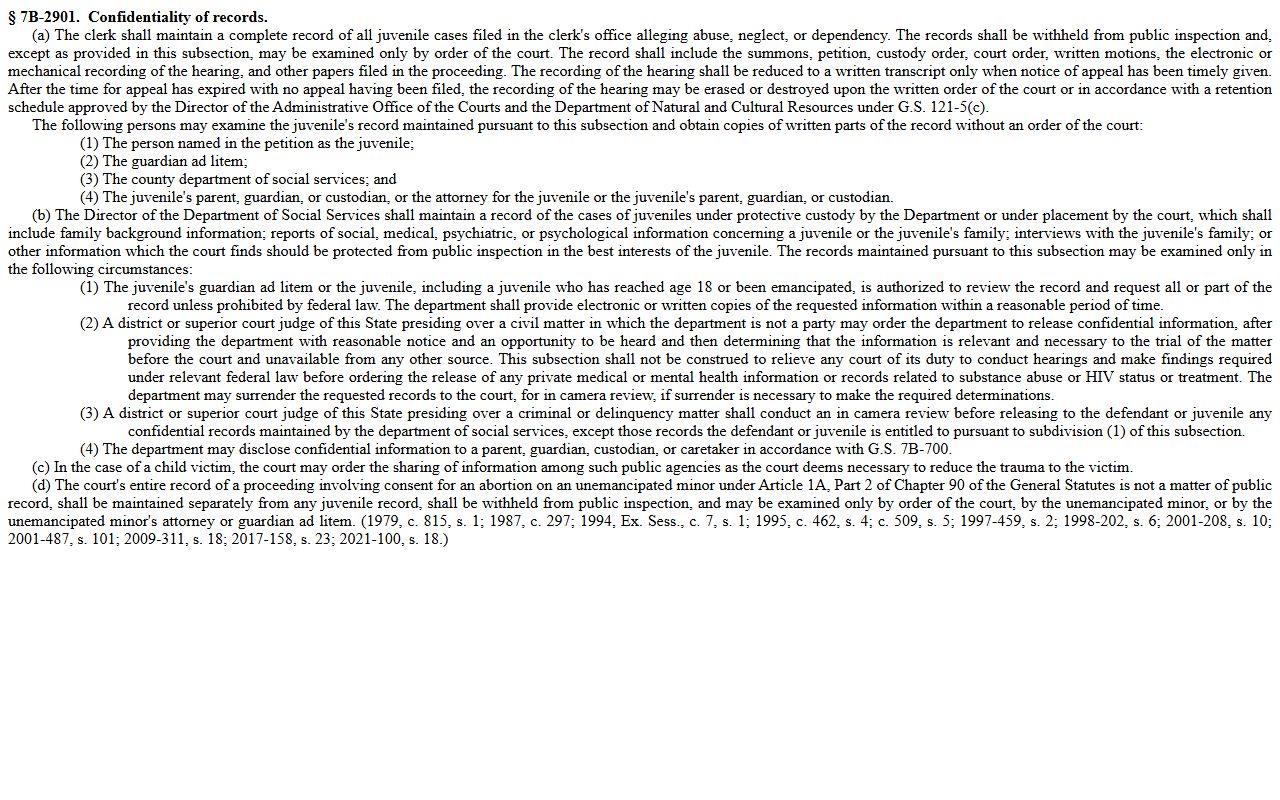
Confidential juvenile and family-related files should not be treated like ordinary adult criminal court records.
Wake County Criminal Record Contacts
For criminal court records, start with the Clerk of Superior Court and the criminal case contacts in the Wake County court directory. For prosecution questions, the DA is the public office for the State's criminal case work. For appointed counsel, the Public Defender is relevant only to clients or appointed-counsel status. For jail custody or booking records, use jail and sheriff records channels instead of treating them as the court case file.
Wake County Justice Center
300 S. Salisbury St.
Raleigh, NC 27601
919-792-4000
Criminal matters and marriages.
District Attorney, Prosecutorial District 10
PO Box 31
Raleigh, NC 27602
919-792-5000
Fax 919-792-5001.
The final criminal-records image comes from the U.S. Attorney's Office for the Eastern District of North Carolina.
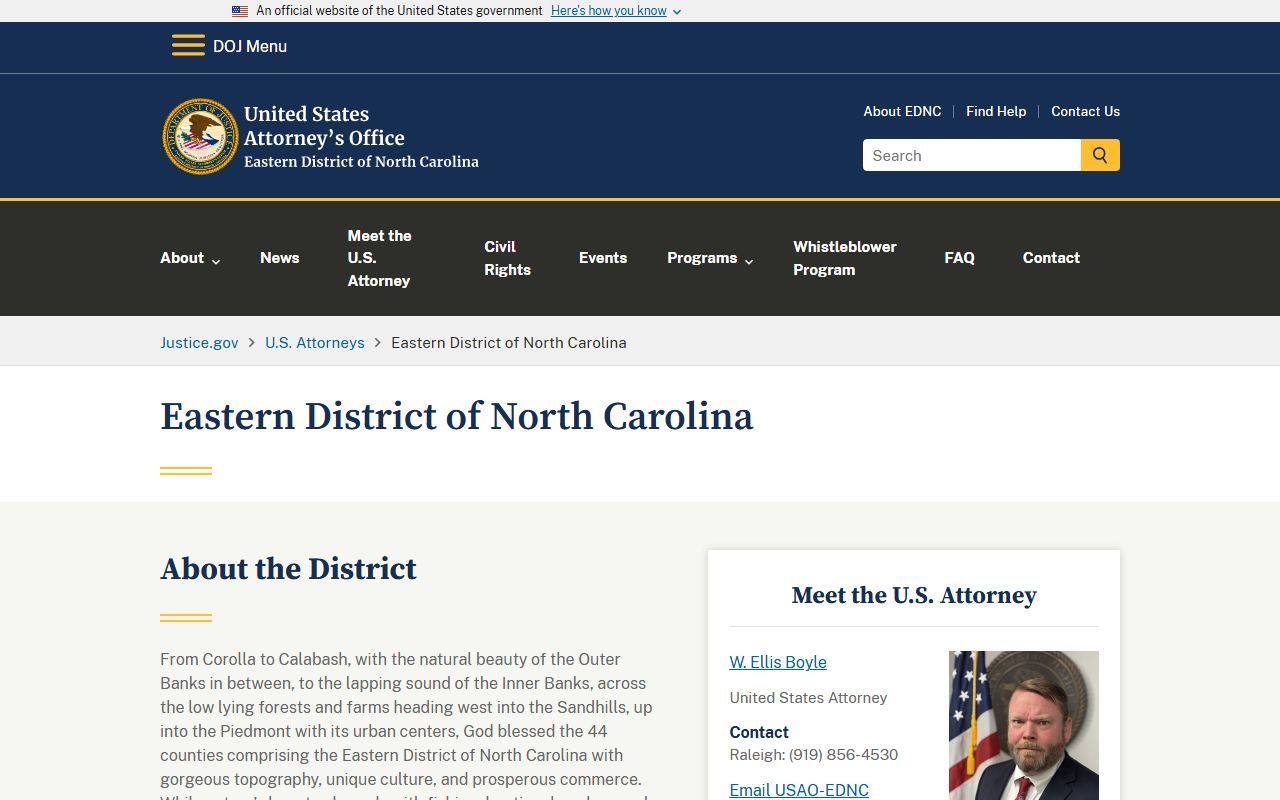
Federal prosecutions are separate from Wake County criminal court records in state Superior Court and District Court.